
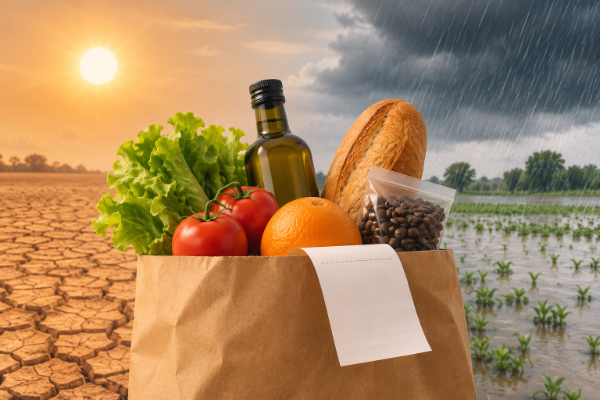
Most of us think of climate change as melting glaciers, wildfires, or rising seas, something that happens far away from the supermarket aisle. But economists are finding that one of the first places ordinary people feel it is at the checkout. Heatwaves, droughts, and floods damage crops, and when harvests shrink, prices rise. This article looks at how extreme weather ends up in your shopping basket, using real price data and a landmark study that connects temperatures to inflation, and asks what it could mean for families around the world in the years ahead.
What Economists Mean by "Climateflation"
Inflation is the general rise in prices over time, and it is normally linked to things like interest rates, wages, and energy costs. In March 2022, soon after Russia invaded Ukraine, the German economist Isabel Schnabel used the word "climateflation" to describe a new kind of inflation driven by climate change. A few months later the news outlet Grist suggested a narrower term, "heatflation", because the biggest price effects seem to come from extreme heat rather than from changes in rainfall. Researchers behind a major study found no strong link between shifts in precipitation and inflation, but a clear link with high temperatures. The idea sounds abstract, but it is easy to picture: if wheat withers in a heatwave, flour gets more expensive.
Why Food Is the First Place Climate Change Hits Your Wallet
In 2023, researchers from the Potsdam Institute for Climate Impact Research and the European Central Bank studied monthly price data from 121 countries between 1996 and 2021. They found that food prices are the part of inflation most strongly linked to climate, because heat and extreme weather cut agricultural productivity. In other words, when a heatwave damages crops, there is simply less food to sell, and economists call that a supply shock. The effect was not limited to tropical countries. Rising temperatures were associated with higher food inflation in places that are already hot and also in countries outside the tropics, including the United States.
The 2022 European heatwave is a good example. Researchers estimated that it pushed food prices up by about two-thirds of a percentage point and overall inflation by about one-third of a percentage point. (A percentage point is the simple difference between two percentages, so food inflation going from 3% to 3.67% is a rise of 0.67 percentage points.) That might sound small, but food is something people buy every week, so even a small rise is felt in every household.
Chocolate, Olive Oil, and Coffee: A Case Study
You can see this clearly in a few everyday products. In February 2024, cocoa prices hit a record high after dry weather hit harvests in West Africa, where Ghana and Ivory Coast produce most of the world's cocoa. According to an HSBC research note from that time, cocoa was up 123% year on year, olive oil had risen around 70% in a year to a record, Robusta coffee was up about 55%, and orange juice was up about 50%. In Canada, a litre of olive oil went from around $9 at the end of 2022 to over $14 in early 2024, according to Statistics Canada figures cited by a McMaster University economist. Weather was not the only factor behind these jumps, since shipping problems and strong demand also played a role, but drought in the Mediterranean and unusual weather in West Africa were major drivers. For shoppers, it showed up as smaller chocolate bars and pricier salad dressing.
When Governments Step In: The Rice Example
Staple foods can be affected too. In July 2023, rice prices in Asia rose to their highest level in more than two years because of concerns that dry weather would damage crops, and export bans were expected to continue into 2024. Export bans are when a government restricts how much of a product can be sold abroad, usually to protect supply and prices at home. They can make sense for one country, but they reduce the amount available on world markets, which can push prices up for importing countries. This shows how a weather problem in one region can spread through trade to families thousands of kilometres away.
Why You Can't Just Stop Buying It
Economists describe food as "inelastic", meaning people keep buying it even when it gets more expensive, because we need to eat. When supply drops but demand stays the same, prices have to rise. As one economist put it, olive oil demand stayed high while supply fell, so prices were unlikely to drop any time soon. This is basic supply and demand, but climate change makes the supply side less predictable from year to year, which is what makes budgeting harder for households and businesses.
A Closer Look at Ukraine
Ukraine is often called the breadbasket of Europe because of the grain and sunflower oil it exports to the world. When the 2022 heatwave hit Europe, it arrived on top of food prices that were already soaring because of Russia's invasion. This is an important point for understanding climate and food together: extreme weather rarely acts alone. War, supply chain problems, and energy costs all interact with it, and climate change can make each of those problems harder to manage. For a country like Ukraine, where farmland, ports, and transport routes are all under pressure, protecting food production is an economic and an environmental challenge at the same time.
Who Pays the Most
The study's projections suggest the problem will grow. Without strong action on emissions, extreme weather could add roughly 1.5 to 1.8 percentage points to global food inflation each year by 2035, and around 0.8 to 0.9 points to overall inflation. By 2060, the researchers projected the climate-driven part of food inflation could reach 2.2 to 4.3 percentage points a year. The impact would be strongest in regions that are already hot, especially in Africa and South America, where families spend a larger share of their income on food. A price rise that feels annoying in one country can mean skipping meals in another.
Can Anything Be Done?
Researchers note that even in a best-case scenario where the world meets its Paris Agreement climate targets, food inflation is still expected to rise somewhat, so the goal is to limit the damage rather than avoid it completely. The study also suggests that adapting to climate change, for example through new farming technology and crops that handle heat better, could help hold down future price rises. In practice, that means governments and businesses supporting farmers, investing in water-saving irrigation, storing and sharing food supplies more smartly, and cutting greenhouse gas emissions in the first place. Individuals can contribute too, for instance by wasting less food and supporting local producers when it makes sense.
Conclusion
Climate change is a cost-of-living issue. The next time a favourite snack or a bottle of olive oil costs more than last year, extreme weather may be part of the reason. Understanding this link matters for consumers, but also for governments and businesses deciding how to adapt. The grocery bill is one of the most personal places where the climate crisis becomes an economic story, and it shows why protecting the environment and protecting household budgets are, more and more, the same task.
Sources:
-
https://grist.org/economics/heatflation-study-extreme-weather-food-prices/
-
https://cbsnews.com/news/climate-change-food-prices-inflation-3-percent-study
-
https://www.weforum.org/stories/climate-action/climate-change-food-prices-drought/